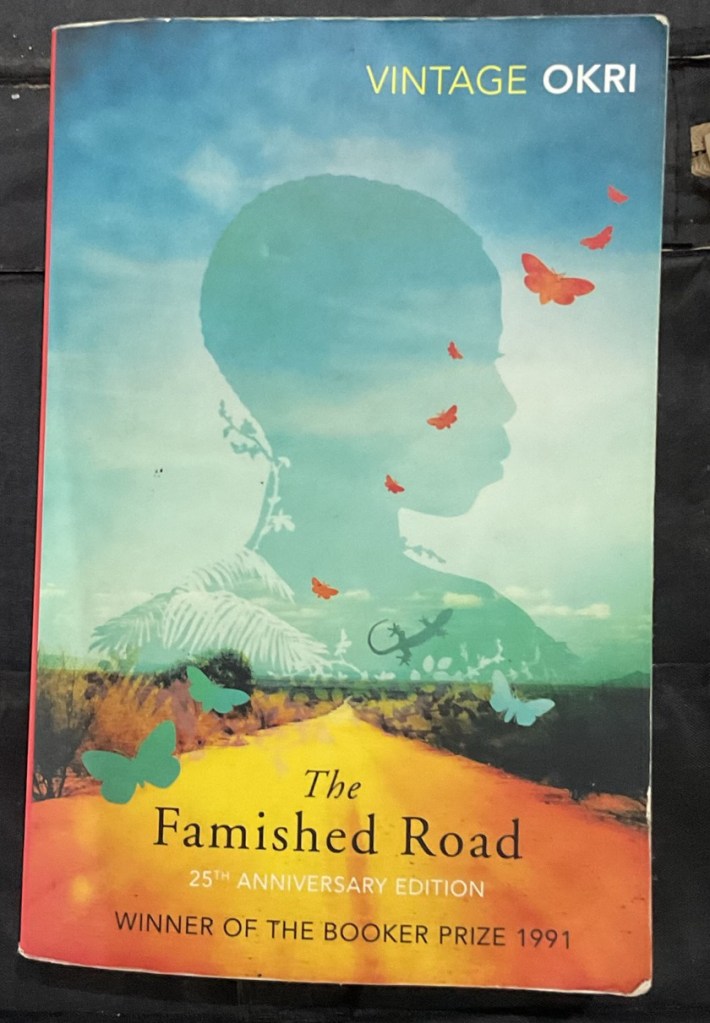
I started my journey on The Famished Road after One Hundred Years of Solitude.
It was 2020, the spring of my last year of college and the peak of the pandemic. The world had shut down except for the online world and the world of letters.
I took to the latter, as the headlines on newspapers were grim, reminding me of my unending quarantine to save the world.
For context, a year earlier, I had just finished Gabriel Garcia Marquez One Hundred Years of Solitude. In fact, it was my first encounter with magical realism. I thoroughly enjoyed the vivid imagery of Macondo, where the real and irreal intertwine, suspending my belief. It whet my appetite so much so that I was famished for another novel in that calibre. That’s how I came across Ben Okri’s acclaimed novel:
The Famished Road – Booker Prize winner 1991
Set in a ghetto in Nigeria, the story follows the life of Azaro, an abiku or spirit child. According to Yoruba oral tradition, a spirit child is a child that always returns from death to torment the mother in the form of a miscarriage, premature death or near death experiences. That is Azaro’s fate, as he wrestles between living and dying, inadvertently antagonising his worried mother. His spirit friends tempt him to return to his ancestral home but his parents summon him back time and time again, with the help of herbalists and powerful healers. This motif of reoccurrence spans within the eight book novel about 570 pages long. With no true beginning or end, the story challenges narrative conventions, giving us something new in terms of style. However, his experimentation lacks a clear plot so the resolution of the story remains unclear as does its direction. Stakes for the reader are hard to grasp making the reading difficult, particularly the dreary middle.
It took me six years to finish this book.
I lost interest with each sitting. It was not a matter of poor writing than it was contrived plotting. Every time I returned to the road, I never felt like I missed anything because no details felt lost on me. Nothing would radically change plot wise because of the cyclical nature of life in the ghetto: debt, political rallies, natural disasters, spirit walks and boxing matches.
I like to pride myself on finishing what I started, so I was called to task in the reading experience. It challenged my stand: should all books we start be finished?
This was not true in other areas on my life. How many of us abandon a series or movie or even a meal halfway through? Surely a book is no different. There is widespread opinion among readers that one should discontinue a book if the reading proves disengaging — even if it is acclaimed. Time is short. Books are in abundance. Why suffer through one story when there are many better or more compelling stories out there. Is that not a better use of our time?
I asked myself why I started reading it in the first place. Was my goal to complete, appreciate, study or enjoy it? As a writer, I often conflate reading for leisure with studying, as I like to adopt techniques from other writers even if the work isn’t to my taste. For instance, The Rainmaker, which was long listed for the Botswana Literature Awards 2025, was deeply influenced by the conventions of magical realism. My respects to Okri and Marquez who taught me.
Nonetheless, The Famished Road made me realise the answer. What started as a journey of discovery and appreciation turned into a completionist quest. I didn’t want to quit. If I could read Ulysses, what could I not do? Honestly, it was hard to recognise the shift from one mode of reading to another. Some books request the change and I happily oblige. This was not the case. I digress.
Once three years in and halfway through, it’s hard to give up on the book. While a war of attrition is no desirable reading strategy, it gets the job done—eventually. I would say that my main contention was the density of descriptions. It felt like a roll call of fantastic figures and mannerisms in a scene without giving them breathing room. It overwhelmed me.
Here’s an example from one of the shorter sections:
“
THAT EVENING THERE was the most fantastic gathering at Madame Koto’s bar. There were yellow vans every-where. Curious perfumes floated over the road. A great number of cars were parked along the lanes and side streets. Music rocked all night, making the houses tremble along the road. Women were attired in matching lace, in identical handwoven materials. Their imitation gold bangles and necklaces, brooches and rings of cheap rubies, their indispensable high-heeled shoes, glittered under the lights. The women were all over the place, bursting with scandalous sexuality.
Short, powerful men with chieftains’ beads round their necks and fans of eagle crests in their hands; men with big feet and white shoes; men with bulbous ancient eyes and protruding stomachs, who moved with the lumbering gait of unalterable clannish power; men who were almost giants, with thick necks and sweating thunderous brows and thighs of timber-like virility; all were there. They were the inheritors of titles and extensive acres of land.
There were children in red, whole families in matching silk materials, an old man with a parrot, herbalists, ritual-ists, cultists, and a short man with a white cap and a string of goats for the great sacrifice. I saw them bring in a strange-looking animal, a duiker with penetrating eyes. They all clustered in the bar” (Okri 515).
Understandably, this scene is a party with a lot of guests. My issue here is in the density. For example, we are told that all sorts of people are there. Then we get a list, but its effect is lost on us as the images are competing for foreground and presence in the reader’s mind. Before I can contemplate the women “bursting with scandalous sexuality” – whatever that means here. An entourage of men follow but the bizarreness and singularity of one of men’s “bulbous ancient eye and protruding stomach” is entangled with giants and chieftains. One paragraph later we shift to more periphery characters that don’t add to the story but occupy the space like the herbalist bringing in a duiker.
It’s not that Okri abandons them mid-chapter; they pop up again in comical ways, but such extensive descriptions across the story are overwhelming because our attention is spread thin. We should focus on Azaro and his friends and family, not strangers or strange spirits in the room. It’s a common feature in the book whenever Azaro is somewhere crowded.
Here’s my verdict
It’s a good book but not a great book. Walking away from Marquez, one would be left wanting, but there is much to gain from reading the novel. It gives the reader a refreshing perspective of the post colonial condition of Africa, specifically the disillusionment that followed independence. The prose at times has a poetic feel and one is easily immersed in the story world. It’s a good read that could have been half the length and just as good.
Works Cited
Okri, Ben. Famished Road. Vintage: London. 2003.

